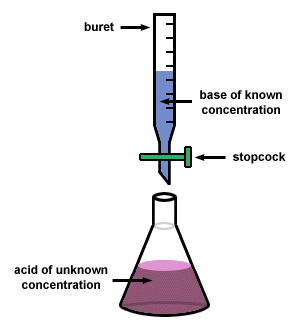
One of the most memorable labs was the day we did titrations. Very briefly, a titration is a way to figure out the concentration of an acid. To do this you slowly add a base that you know the concentration of to the acid. The more base you add, the more neutral the solution will become. When it is completely neutral it changes colors. By calculating how much base you had to put in to make it neutral, you can figure out what the concentration of the acid is. The fun part is adding the one drop completely that changes the solution from clear to pink.
To see how awesome this is, watch this video. You can skip through it. 2:35 is where the solution finally changes. I know I'm geeky, I think titrations are really fun.
Well if you've ever done a titration without the cool technology that tracks everything for you, then you know that this process can take a LONG time. You have to add the base literally one drop at a time, opening and closing the stopcock every time. So it's no surprise that a group got a little impatient and one member finally instructed: "Just blast out 10 [mL]!" So they did. And in the midst of those 10 mL the acid turned neutral and they had no idea at what point it happened so their experiment was ruined.
I was reminded of this experience the other day when I was making rolls. I don't know about you, but every yeast bread recipe I have ever tried calls for about half the flour I actually end up using. Well I had been patiently adding more flour 1/4 c at a time and finally got tired of it and dumped in an entire cup. Well, that was too much flour and while they weren't completely ruined, they weren't the best rolls I've ever made.
But it got me to thinking, why is the exact moment I lose my patience, precisely the moment I need it the most?
So I got to studying patience. In Preach my Gospel (PMG) it defines patience as: "the capacity to endure delay, trouble, opposition, or suffering without becoming angry, frustrated, or anxious. It is the ability to do God's will and accept His timing."
It goes on to explain: "When you are patient, you hold up under pressure and are able to face adversity calmly and hopefully. Patience is related to hope and faith—you must wait for the Lord’s promised blessings to be fulfilled. You need patience in your everyday experiences and relationships, especially with your companion. You must be patient with all people, yourself included, as you work to overcome faults and weaknesses."
It described 3 patient people: Christ, Job, and Joseph Smith. I realized that patience is perhaps the most important Christlike attribute. It encompasses faith, hope, humility, knowledge, and diligence. The most Christlike people are also the most patient people.
Here are a few quotes I really liked:
Life is full of difficulties, some minor and others of a more serious nature. There seems to be an unending supply of challenges for one and all. Our problem is that we often expect instantaneous solutions to such challenges, forgetting that frequently the heavenly virtue of patience is required.
Today in our hurried and hectic lives, we could well go back to an earlier time for the lesson taught us regarding crossing dangerous streets. “Stop, look, and listen” were the watchwords. Could we not apply them now? Stop from a reckless road to ruin. Look upward for heavenly help. Listen for His invitation: “Come unto me, all ye that labour and are heavy laden, and I will give you rest.”
Yet they trusted in the Lord with all their hearts, and they leaned not to their own understanding. In all their ways they acknowledged Him, and He directed their paths.
Some quotes from Neal A Maxwell on the subject:
"Sometimes that which we are doing is correct enough but simply needs to be persisted in patiently, not for a minute or a moment but sometimes for years. Paul speaks of the marathon of life and of how we must "run with patience the race that is set before us" (Hebrews 12:1). Paul did not select the hundred-meter dash for his analogy!"
"Very importantly, it is patience, when combined with love, which permits us "in process of time" to detoxify our disappointments. Patience and love take the radioactivity out of our resentments. These are neither small nor occasional needs in most of our lives."
Put another way, too much anxious opening of the oven door and the cake falls instead of rising. So it is with us. If we are always selfishly taking our temperature to see if we are happy, we will not be.
(I got these out of my Neal A Maxwell quote book but most of them can be found in this talk by him. AMAZING and a definitely must read!)
Here are my favorite quotes:
How often do we hear oppressed souls ask foolishly, “How could God do this to me?” when really they should be praying for strength to “beareth” and “endureth all things.”
Is patience important and worthy of our pondering and pursuit? ... It is if we would seek to become after the manner of Christ.
Recently I attended the funeral of a lifelong friend. His son told a beautiful story of parental patience. When the son was in his youth, his dad owned a motorcycle dealership. One day they received a shipment of shiny new motorcycles, and they lined them all up in the store. The boy did what every boy would like to do, and he climbed up on the closest one. He even started it up. Then, when he figured he had pushed his luck far enough, he jumped off. To his dismay, his dismount knocked the first bike down. Then, like a string of dominoes, they all went down, one after another. His dad heard the commotion and looked out from behind the partition where he was working. Slowly, smiling, he said, “Well, son, we had better fix one up and sell it, so we can pay for the rest of them.” I think my friend’s response personifies parental patience.
Elder Neal A. Maxwell linked patience and faith together when he taught: “Patience is tied very closely to faith in our Heavenly Father. Actually, when we are unduly impatient, we are suggesting that we know what is best—better than does God. Or, at least, we are asserting that our timetable is better than His” (“Patience,” Ensign, Oct. 1980, 28).
I didn't copy over very much from this talk because I wanted this post to be short. If I would have copied everything I liked it would have been the entire talk! He also gives a formula to help us become more patient. I highly recommend that you go read the talk :)


